
AI in Kerala Schools: Inside the KITE Model

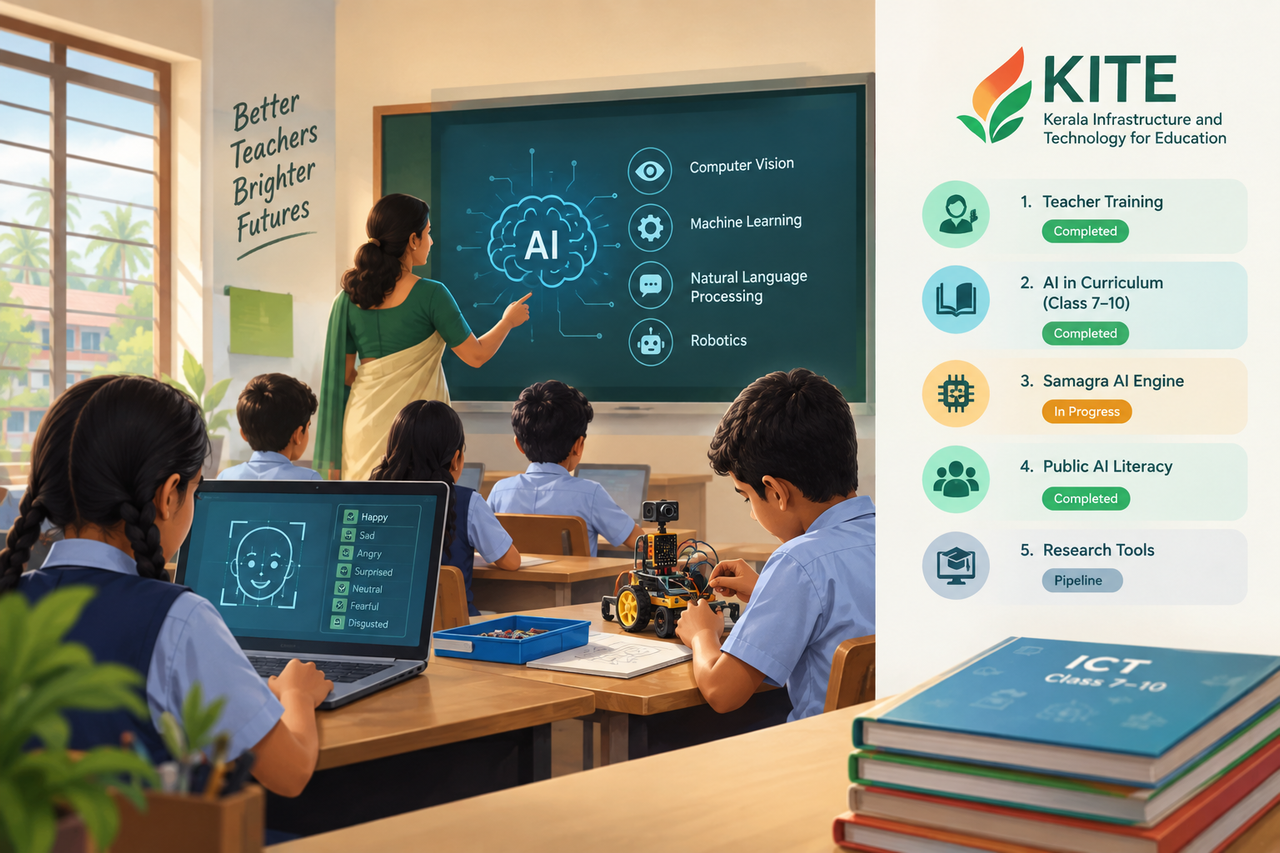
Kerala trained 80,000 teachers in AI, put it in the Class 7 textbook and built its own AI engine. What the KITE model contains, and what it has not solved.
While most of the world is still debating whether AI belongs in classrooms, Kerala has been running it at scale for two years. The state trained its secondary school teachers in AI in 2024, put AI into the official ICT textbook from Class 7, deployed 29,000 robotics kits, and built its own curriculum-aligned AI engine inside the public sector rather than buying one. This is what the KITE model actually contains, what it deliberately refused to do, and the problems it has not solved yet.
What KITE is, and why the scale matters
KITE, the Kerala Infrastructure and Technology for Education, is the technology arm of the state's General Education Department. It has been running for roughly 25 years, and the infrastructure underneath the AI work is the part people usually skip. On its own account, KITE has deployed more than 2.5 lakh laptops and 70,000 projectors across 16,000 schools, with broadband in classrooms, and has trained more than 2 lakh teachers in ICT.
One design decision shaped everything that followed. Teachers themselves became the trainers, with no external IT vendors in the loop. The content is built on free and open source software, authored by Kerala teachers. That is why the AI rollout could move quickly in 2024: the training machinery, the hardware and the teacher network already existed.
The contrast worth drawing is with how AI usually enters a school anywhere else. A vendor sells a platform, a few teachers are trained on that platform, and the school becomes dependent on it. Kerala went the other way, and the consequences of that choice run through every part of what follows.
The five stages, and where each one stands
KITE describes its AI work as five sequenced stages, each with a named beneficiary group and a status.
AI training for teachers, covering the technology, teaching tools, pedagogy and responsible AI. Marked completed.
AI in the school curriculum from Class 7, with practicals, robotics, ethics and inclusive learning. Marked completed.
The Samagra AI engine, integrating large language models to deliver curriculum-aligned services. Marked in progress.
AI literacy for the general public through a video series on the KOOL platform and the VICTERS channel. Marked completed.
AI-enabled research tools for scholars and faculty. Marked as in the pipeline.
The teacher training is the piece that got national attention. As reported by IndiaAI, KITE set out in 2024 to train 80,000 teachers of Classes 8 to 12 through a three-day programme, starting with 1,856 teachers across 70 centres, with training for Classes 1 to 7 teachers following later that year. The curriculum covered summarisation, image generation, prompt engineering, machine learning, data visualisation and AI-assisted assessment, alongside deepfakes, privacy and algorithmic bias.
What AI actually looks like in Classes 7 to 10
This is the part most coverage gets wrong by treating it as a vague "AI chapter". It is a four-year progression inside the official ICT textbook, and each year is built around something students make.
Class 7: How AI works
An introduction to the technology, then computer vision and face detection. Students build a program that recognises seven facial expressions using a pre-trained model, working in block programming through PictoBlox. The year also covers gesture-based software for children with special needs.
Class 8: Machines that learn
Supervised, unsupervised and reinforcement learning. The activity is building a machine learning model that recognises Indian Sign Language, then turning it into an interactive ISL letters game. Students go through dataset preparation, training and testing themselves.
Class 9: Intelligent machines
Natural language processing and how it works, large language models and interacting with one, prompt engineering, text generation and image creation with generative AI, and an introduction to AI agents in learning.
Class 10: The world of robots
Robotics and AI fundamentals, then building a working model of a smart door that opens through face recognition, using a pre-trained model with an Arduino, a webcam and a servo motor.
Two things stand out. The projects are physical and specific rather than conceptual, and the Class 8 sign language project builds something with a real user at the end of it. That is a different proposition from teaching children to write prompts.
Samagra Plus AI: the state built its own engine
Rather than licensing a commercial edtech AI, KITE built Samagra Plus AI inside the public sector. It now holds more than 5,000 AI-generated learning resources, all vetted by teachers under what KITE calls a teacher-in-the-loop model. Textbook eResources for Classes 5 to 10 were folded into the AI engine in 2025, with higher secondary core subjects following.
Six services run on top of it.
A Teaching Manual generator that maps manuals to the curriculum and learning outcomes and suggests classroom activities.
Multilingual translation of those manuals into English, Malayalam, Tamil and Kannada, powered by BHASHINI.
A curriculum-aligned chatbot that explains concepts using approved digital resources, available around the clock.
A quiz generator producing formative assessments at multiple difficulty levels.
A higher order thinking skills generator producing descriptive questions, with AI-based answer evaluation.
Let's Talk, text and voice bots for speaking practice on everyday topics.
In February 2026 the state launched Key to Entrance, a free AI-driven entrance coaching programme for higher secondary and vocational higher secondary students in public schools, reported by PTI as reaching eight lakh students across Science, Commerce and Humanities. KITE says the question bank runs to more than 30,000 AI-generated questions vetted by subject teachers, with personalised study plans generated from each student's performance. Principals were instructed to make facilities available in school for students without personal devices or internet at home.
What Kerala deliberately refused to do
KITE lists eight problems it set out to solve, and read as a set they amount to a position on what public education should not hand over.
No vendor lock-in. The stack is built on free and open source software rather than a commercial platform.
No third-party data sharing. Processing runs on local servers, with vetted datasets.
No child profiling and no data to advertisers. KITE explicitly frames this as a response to a 2022 Human Rights Watch investigation which found several edtech platforms used in India shared sensitive data with third-party advertisers.
No replacing the teacher. KITE states the AI assists and never replaces the human mentor, which is what the teacher-in-the-loop vetting is for.
No publicly unauthored curriculum. The material is written inside the system, age-appropriate, rather than adapted from a vendor.
No assuming connectivity. Offline-ready tooling is a stated design requirement, given how uneven classroom internet is.
Whether or not you agree with every choice, the interesting thing is that these were decided before deployment rather than after an incident. Most institutions are writing their AI rules now, retroactively, around tools they already bought.
The parts that are not solved yet
KITE publishes its engineering problems openly, which is unusual for a government body and worth taking at face value.
Compute cost. Running modern language models needs expensive GPUs, and KITE's answer has been an optimised open source stack with infrastructure shared across services to spread the cost.
No government-sector GPU cloud. KITE notes that GPU cloud providers are not available within the government sector, which creates dependency on private clouds, and says it has architected for portability while pursuing on-premise and indigenous options.
Maths and physics reasoning. Language models are weak here, and KITE states it has used the DeepSeek API for advanced reasoning while keeping the core flow on the Kerala stack. It also lists reducing that recurring external API cost, by training and hosting its own reasoning models, as an open goal.
Offline access. Deploying capable local models to schools without reliable internet is named as a current focus area rather than a solved problem.
One claim deserves a closer look. KITE describes its retrieval-augmented generation architecture as delivering zero hallucinations. Grounding a model in a curated, teacher-authored knowledge base does substantially reduce invented answers, and for a school system that is the right architecture. But retrieval reduces hallucination rather than eliminating it, and a system that tells teachers it cannot be wrong is a system teachers will stop checking. The teacher-in-the-loop model is the real safeguard here, not the architecture.
Scale is worth watching too. The public AI literacy course on KOOL, a four-week AI Essentials programme covering ethical use, deepfakes and everyday applications, has trained 1,216 people across three batches at a mentor ratio of one to twenty. That ratio is the reason the course is good and also the reason it is small. Kerala has not yet found a way to give the general public what it gave its teachers.
What the rest of us can take from it
The transferable lessons are not about Kerala's budget, which most schools do not have.
Train the teachers before the students. Every stage of the KITE sequence starts with the adults in the room, and the first stage was completed before the curriculum stage began.
Make the trainers internal. Kerala used its own teachers rather than vendors, which is slower to start and far cheaper to sustain.
Ground the AI in your own material. The reason Samagra can answer curriculum questions usefully is that teachers built the knowledge base it retrieves from.
Decide the data rules before deployment, not after.
Build things, do not just discuss them. A smart door and a sign language recogniser teach more about what AI can and cannot do than any explanation of how a model works.
For schools outside the public system that want the same sequence without building it from scratch, Edapt runs Hello AI with partner schools across Kerala, and AI workshops for working professionals for teachers and staff.
Frequently asked questions
What is KITE in Kerala?
KITE is the Kerala Infrastructure and Technology for Education, the technology arm of the state's General Education Department, formerly IT@School. It has run Kerala's school technology programmes for around 25 years, covering teacher training, curriculum content, hardware deployment, the VICTERS educational channel and school e-governance.
Was Kerala the first Indian state to teach AI in schools?
Kerala introduced AI into its official school ICT curriculum in 2024 and is widely reported as the first Indian state to do so. AI content begins in Class 7 and runs through Class 10.
How many teachers in Kerala have been trained in AI?
KITE set out in 2024 to train 80,000 teachers of Classes 8 to 12 through a three-day AI programme, beginning with 1,856 teachers across 70 centres, with training for Classes 1 to 7 teachers following later that year.
What do Kerala students actually learn about AI?
Class 7 covers how AI works, with a computer vision project recognising seven facial expressions. Class 8 covers types of machine learning, with students building an Indian Sign Language recogniser. Class 9 covers natural language processing, large language models, prompt engineering and AI agents. Class 10 covers robotics, including building a smart door that opens by face recognition using Arduino, a webcam and a servo motor.
What is Samagra Plus AI?
Samagra Plus AI is Kerala's own AI learning platform, built inside the public sector rather than licensed from a vendor. It holds over 5,000 teacher-vetted AI-generated resources and offers a teaching manual generator, multilingual translation via BHASHINI, a curriculum-aligned chatbot, a quiz generator, a higher order thinking skills generator with AI answer evaluation, and speaking practice bots.
What is Key to Entrance?
Key to Entrance is a free AI-driven entrance exam coaching programme KITE launched in February 2026 for higher secondary and vocational higher secondary students in Kerala's public schools. PTI reported it as reaching eight lakh students across Science, Commerce and Humanities streams, with more than 30,000 AI-generated, teacher-vetted questions and personalised study plans.
What are Little KITEs?
Little KITEs are school IT clubs run under KITE, described as the largest pupil IT club in India with more than 2 lakh active mentors. A UNICEF study in 2023 led to the programme being described as a global model in education in 2024. Club members have run cyber safety training for four lakh mothers, and Class 10 members have been eligible for 5 percent grace marks since 2020.
Does Kerala's school AI use ChatGPT or Gemini?
The core platform is built on a free and open source stack with teacher-authored datasets on local servers. KITE states it has used the DeepSeek API for advanced mathematics and physics reasoning, and lists replacing that external dependency with its own hosted reasoning models as a goal.
Can schools outside Kerala use this?
The platform itself is built for Kerala's curriculum and its public school system. The transferable part is the sequence: train teachers first, use internal trainers, ground the AI in your own teaching material, and settle the data rules before deployment. More analysis of this kind is published on the Edapt blog.
Where this leaves things
The reason this story matters beyond Kerala is that it is the only large example of a public system building its own AI for schools instead of buying one. Most of the debate about AI in education is conducted as a forecast. Kerala has two years of an actual answer, including the parts that did not work.
If you run a school, the useful question is not whether to copy Kerala. It is which of its decisions you have already made by default. Whether your teachers were trained before your students. Whether the AI answers from your syllabus or from the open internet. Whether anyone decided what happens to your students' data, or whether a vendor decided it for you.
Sources
KITE, The KITE Model for Responsible AI, the state's own account of its AI stages, curriculum, engineering challenges and design decisions.
KITE, Kerala Infrastructure and Technology for Education, for organisational background and programme history.
Samagra Plus AI and KOOL, for platform detail and public course figures.
IndiaAI, Kerala launches AI training programme for 80,000 school teachers, for the 2024 teacher training rollout.
Press Trust of India reporting, February 2026, for the Key to Entrance launch and its eight lakh student figure.