
The Future of AI: 8 Major Trends That Will Define 2026
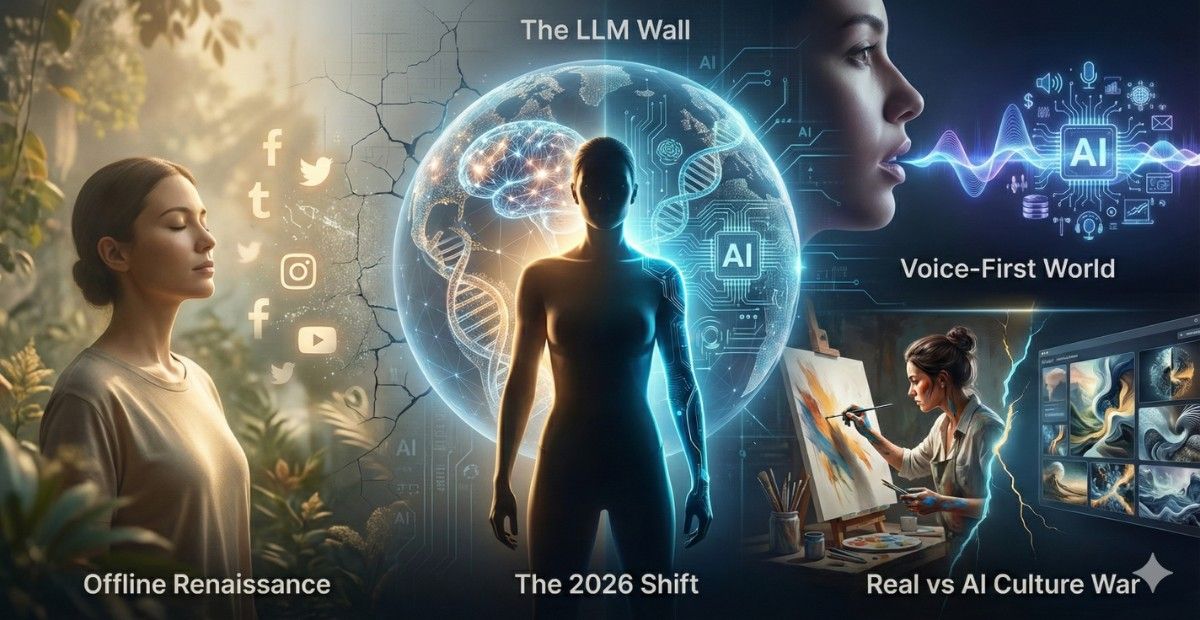
Is 2026 the year we finally put our phones down? Looking at the current trajectory of technology, 2026 is shaping up to be a defining year for artificial intelligence, human behavior, and the global economy. Here's a breakdown of the major trends that experts believe will reshape our lives very soon.
The Future of AI: 8 Major Trends That Will Define 2026
Is 2026 the year we finally put our phones down? The answer seems to be a complicated "yes." While society appears to be stepping away from traditional social media, we are simultaneously stepping into a world dominated by voice assistants, smart glasses, and medical breakthroughs.
Looking at the current trajectory of technology, 2026 is shaping up to be a defining year for artificial intelligence, human behavior, and the global economy. Here is a breakdown of the major trends that experts believe will reshape our lives very soon.
Key Takeaways
- The Offline Renaissance: People are hitting "peak social media" and trading smartphones for flip phones and real-life communities.
- Voice-First World: We will type less and talk more as AI becomes reliable enough to handle complex tasks via voice commands.
- Smart Glasses Go Mainstream: Apple, Google, and Meta are expected to push eyewear that reduces our reliance on handheld screens.
- Evolution of AI Models: We may hit the limit of current text-based AI and shift toward "World Models" that understand physics and reality.
- AI in Healthcare: Expect a massive medical breakthrough driven by AI, proving the technology's necessity.
1. The Offline Renaissance
After years of digital saturation, data suggests we have reached "peak social media." Time spent on these platforms is declining, particularly among younger users. In 2026, expect an "offline renaissance" where disconnecting becomes the ultimate social flex.
We are already seeing the rise of "dumb phones" (basic handsets from the late 90s or early 2000s with no apps) and a surge in offline activities like run clubs and speed dating. People are tired of the "doom scroll" and the flood of AI-generated content, preferring genuine, face-to-face community over digital noise.
2. A Voice-First Society
As we move offline, ironically, AI will help us stay there. Predictions suggest we are rapidly moving toward a voice-first economy. As AI assistants (like Siri or Gemini) become more intelligent and reliable, we won't need to open apps to order groceries or send emails.
Instead of typing prompts or tapping screens, we will simply speak to our devices. This breaks the addictive loop of opening a phone and getting distracted, allowing technology to exist in the background rather than demanding our full attention.
3. The Year of AI Glasses
If we aren't looking at our phones, where are we looking? Likely through smart glasses. While Meta has already entered the space, 2026 could see major releases from other tech giants like Apple and Google.
Smart glasses allow users to interact with AI assistants without breaking eye contact with the world. Just as smartphones were once predicted to fail before becoming essential, smart glasses are poised to become the new standard for computing on the go, reducing the need to carry a handheld screen.
4. Hitting the Limits of LLMs
This is a crucial technical shift. We may soon hear that Large Language Models (LLMs) have reached their capacity. Current AI predicts the next word in a sentence, but it doesn't truly understand the physical world.
The future lies in World Models. Unlike LLMs, World Models are designed to simulate reality. They digest video, audio, and sensor data to understand physics and cause-and-effect. A robot needs to know that a glass will break if dropped, not just predict the word "break." This shift is essential for the development of reliable self-driving cars and advanced robotics.
5. The Tech Resistance
With AI disrupting the workforce, 2026 may see the rise of organized resistance against artificial intelligence. As companies downsize or restructure for AI efficiency, workers may push back, demanding better social safety nets and reskilling programs.
This isn't just about jobs; it's about cognitive fatigue and the flood of disinformation. Expect social movements that demand a "bargain" with the tech industry regarding how AI is integrated into human life and protection for those displaced by automation.
6. AI Goes Mainstream in Politics
Until now, politicians have mostly spoken about AI in vague terms. The prediction for 2026 is that major political candidates will make AI the centerpiece of their campaigns.
This won't be generic fear-mongering. It will likely be detailed plans addressing how to protect jobs, transform education, and manage national security in an AI-driven world. The conversation will shift from "AI is coming" to specific policy plans on how to handle it.
7. A Cultural Split in Entertainment
Get ready for an AI-generated song or character to go viral—not because it's a novelty, but because it's actually good. This will cause a massive cultural divide.
One side of society will accept the content as valid entertainment, while the other will reject it as a mockery of human art and a copyright nightmare. This moment will force audiences to decide what they value: the final product or the human effort behind it.
8. A Medical Breakthrough
Perhaps the most hopeful prediction is a major victory in healthcare. Researchers have been quietly building AI models specialized in biology, targeting cancer, neurodegenerative diseases, and autoimmune disorders.
In 2026, we could see the first undeniable proof of AI solving a medical problem that humans couldn't solve alone. This "penicillin moment" for AI will likely unite people, proving that despite the fears and job losses, the technology is a medical necessity for our future survival.
Conclusion
The year 2026 appears to be a crossroads. We are simultaneously rejecting digital addiction while embracing even more advanced technology to manage our lives. Whether it's wearing smart glasses or trusting an AI to cure a disease, our relationship with technology is about to become much more intimate—and much more complex.