
n8n 2.0: The New Standard for Enterprise Automation
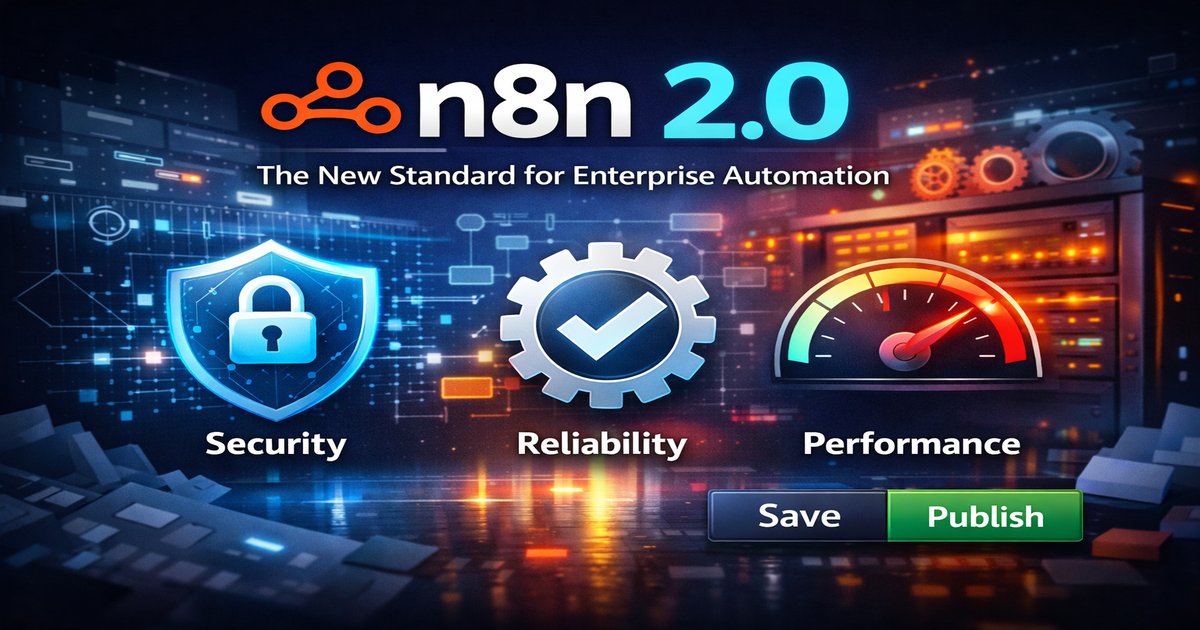
The major update to n8n is officially live and stable. With Version 2.0, the platform has made the leap from a flexible automation tool to a hardened, enterprise-grade system with security, reliability, and performance at its core.
The major update to n8n is officially live and stable. With Version 2.0, the platform has made the leap from a flexible automation tool to a hardened, enterprise-grade system.
After a month in stable release, the impact of these changes—focused on security, reliability, and performance—is already reshaping how mission-critical workflows are built. If you haven't upgraded yet, here is everything you need to know about the new standard.
The Core Focus: Security, Reliability, Performance
Version 2.0 wasn't just a feature drop; it was a maturity upgrade.
1. Security by Default
The platform has shifted to a "secure by default" philosophy.
Task Runners: These are now enabled by default. Every Code node execution runs in an isolated environment with limited access, preventing accidental system exposure.
Restricted Access: Environment variables are now blocked from Code nodes, and nodes that allow arbitrary command execution are disabled out of the box.
Note: You can still enable the old, permissive behaviors if you need them, but you must now do so explicitly.
2. Reliability & Simplicity
To reduce edge-case bugs, the logic has been streamlined.
Wait Nodes: Sub-workflows with Wait nodes now correctly return data from the end of the workflow rather than the input of the Wait node.
Cleanup: Legacy options and nodes for defunct services have been removed to ensure predictable behavior.
3. Performance Boosts
Bottlenecks have been cleared out.
SQLite Pooling: The new driver is clocking up to 10x faster speeds in benchmarks.
Binary Data: Filesystem-based handling is significantly more predictable under heavy loads.
Feature Spotlight: "Publish / Save"
The most visible change in your daily workflow is the new Publish / Save paradigm.
Old Way: Saving an active workflow instantly updated production.
New Way: You now have separate Save and Publish buttons. You can save edits as a draft without breaking the live production workflow.
Coming Soon: This architecture lays the groundwork for the highly anticipated Autosave feature, which is scheduled to arrive later this month.
Migration: Are You Ready?
Since 2.0 included breaking changes, you cannot just click "update" blindly. You should use the Migration Report tool before moving your instance.
Where to find it: Settings → Migration Report.
What it does: It flags "Critical" issues (nodes that will break) and "Instance-level" config issues.
The Strategy: Fix the critical items, refresh the report, and upgrade only when it comes back clean.
What about v1.x?
If you are still running version 1.x, note that it is currently in its "maintenance mode" window. It will continue to receive security and bug fixes until mid-March 2026, but no new features will be added.